
Key takeaways
- Businesses with revenue of AED 50 million or more must appoint an FTA Accredited Service Provider (ASP) by 30 October 2026 and go live on 1 January 2027.
- All other in-scope businesses must appoint an ASP by 31 March 2027 and go live on 1 July 2027.
- The mandate covers B2B and B2G transactions. B2C sales are excluded.
- Missing the ASP or go-live deadline costs AED 5,000 per month under Cabinet Decision No. 106 of 2025.
UAE e-invoicing is no longer a future project. The Ministry of Finance has fixed the legal framework, the Federal Tax Authority (FTA) has accredited the first service providers, and the first mandatory deadline is weeks away. This guide explains who is caught, by when, what the system actually requires, and how to get ready without disrupting your billing cycle.
What is UAE e-invoicing?
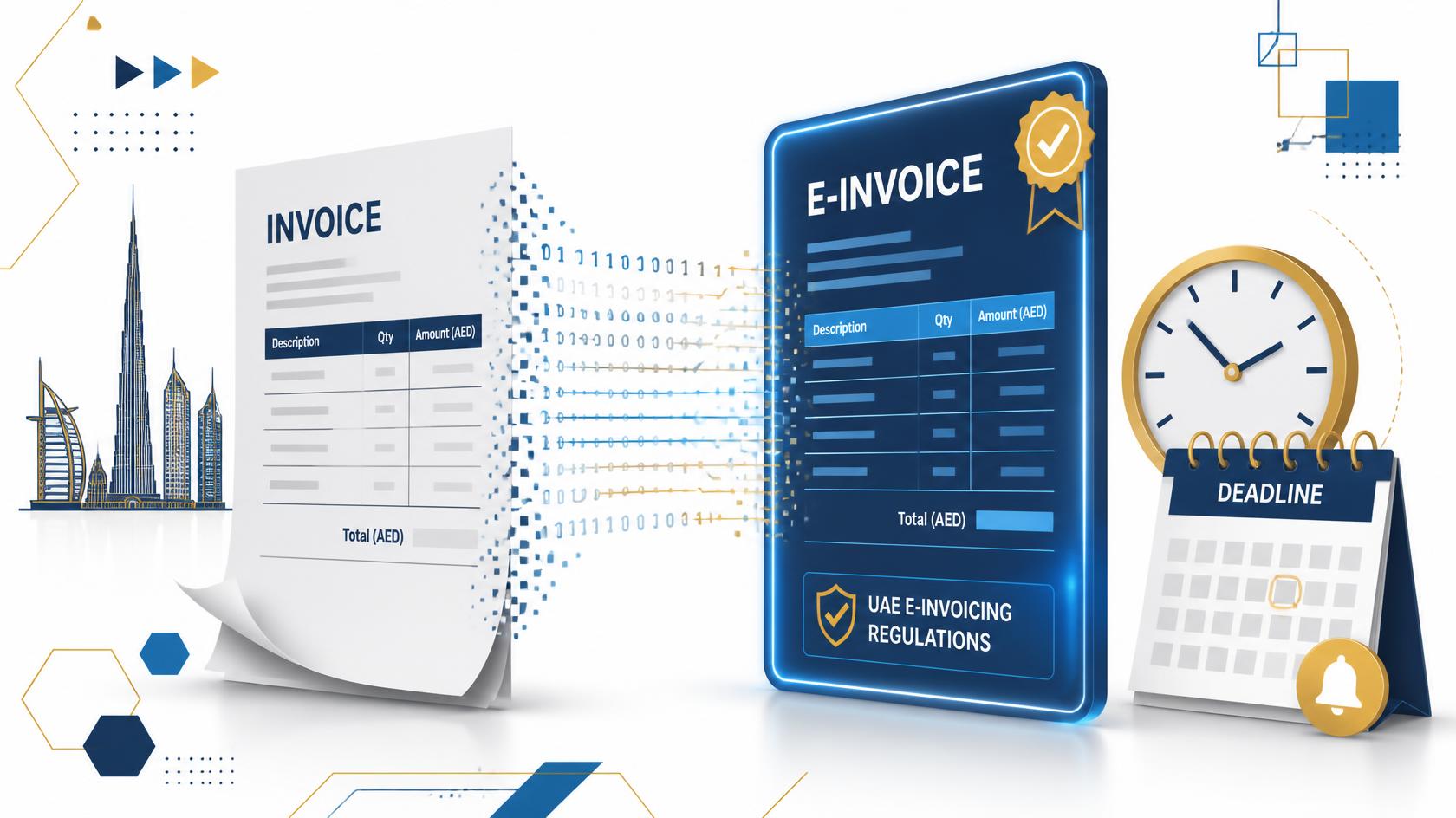
E-invoicing replaces PDF and paper invoices with structured electronic invoices that are exchanged between businesses through accredited platforms and reported to the FTA in near real time. The UAE uses a decentralised “five-corner” model built on the Peppol standard: the supplier sends the invoice through its ASP, the ASP delivers it to the buyer’s ASP, and the invoice data is reported to the FTA’s central platform.
A PDF emailed to a customer will not count as a valid tax invoice for in-scope transactions once your go-live date arrives. That is the practical change most finance teams underestimate.
The legal framework
- Ministerial Decision No. 243 of 2025 defines the scope of the e-invoicing system and the transactions excluded from it.
- Ministerial Decision No. 244 of 2025 sets the implementation phases. It was amended in May 2026 to move the ASP appointment deadline for large businesses from 31 July 2026 to 30 October 2026.
- Cabinet Decision No. 106 of 2025 sets the administrative penalties for non-compliance.
UAE e-invoicing timeline and deadlines
| Group | Appoint ASP by | Mandatory go-live |
|---|---|---|
| Pilot participants / voluntary adopters | — | From 1 July 2026 |
| Revenue of AED 50 million or more | 30 October 2026 | 1 January 2027 |
| Revenue below AED 50 million | 31 March 2027 | 1 July 2027 |
| Government entities | 31 March 2027 | 1 October 2027 |
Revenue for phasing purposes is measured on the most recent accounting period. If your group is close to AED 50 million, confirm which side of the line each entity falls on now rather than in December.
Who is in scope — and who is not
Every UAE business that makes business-to-business (B2B) or business-to-government (B2G) supplies is in scope, whether or not it is VAT registered. The main exclusions under Ministerial Decision No. 243 of 2025 are:
- Business-to-consumer (B2C) transactions.
- Government entities acting in a sovereign capacity and not competing with the private sector.
- International passenger air transport issued with e-tickets, and related ancillary services.
- International air cargo documented by airway bills (for 24 months from the effective date).
- Exempt or zero-rated financial services.
Excluded businesses can still opt in voluntarily, and some of their other transactions may remain in scope. Self-billing arrangements and agents issuing invoices on behalf of principals must use the system.
What an Accredited Service Provider does
An ASP is a technology provider accredited by the FTA to validate, transmit and report e-invoices. It connects to your ERP or accounting software, converts invoice data into the required format, checks it against the mandatory fields, delivers it to your customer’s ASP and reports it to the FTA. Choosing an ASP is therefore an integration decision as much as a procurement decision: the right provider depends on your ERP, invoice volume, multi-entity structure and how much automation you need. See our accredited service provider selection service for a structured comparison.
Tax Identification Number (TIN)
Every participant needs a TIN on the e-invoicing network. For businesses already registered for tax, the TIN is linked to the existing FTA registration. Businesses that are not registered for VAT or corporate tax still need to obtain one before they can send or receive e-invoices — a step that is easy to miss for holding companies and service entities.
Data requirements: the mandatory fields
The UAE data dictionary specifies the fields every tax invoice must carry, including supplier and buyer identifiers, document totals, VAT breakdowns and line-level detail. In practice, the gaps we find most often are:
- Customer master data without a TIN or with inconsistent legal names.
- Item descriptions and units of measure that do not map to the required codes.
- Credit notes issued manually outside the billing system.
- Multiple invoice templates across branches or entities.
E-invoicing penalties in the UAE
Cabinet Decision No. 106 of 2025 sets the following administrative penalties:
- Failure to implement e-invoicing or appoint an ASP on time: AED 5,000 per month (or part of a month) of delay.
- Failure to issue and send an e-invoice or e-credit note: AED 100 per document, capped at AED 5,000 per calendar month.
- Failure to report a system failure to the FTA: AED 1,000 per day of delay.
- Failure to update the ASP on changes to your data: AED 1,000 per day of delay.
A practical e-invoicing readiness plan
- Confirm your phase. Measure revenue per entity and decide whether the 30 October 2026 or 31 March 2027 deadline applies.
- Map your invoice flows. List every system that issues invoices or credit notes, including manual ones.
- Clean master data. Collect TINs and legal names for customers and suppliers.
- Select and appoint an ASP. Compare integration options for your ERP, pricing per document and support.
- Test end to end. Run sample invoices, credit notes and rejections before go-live.
- Update controls. Assign ownership for rejections, system-failure reporting and data changes.
Our e-invoicing readiness assessment covers steps 1–3 in about two weeks, and our UAE e-invoicing implementation services take you through ASP onboarding and go-live. Because e-invoicing data feeds directly into VAT return filing, we also reconcile the first returns after go-live.
Frequently asked questions
Is e-invoicing mandatory for small businesses in the UAE?
Yes, if they make B2B or B2G supplies. Businesses with revenue below AED 50 million must appoint an ASP by 31 March 2027 and go live on 1 July 2027.
Do I need to be VAT registered to be in scope?
No. Scope is based on the type of transaction, not VAT registration. Non-registered businesses still need a TIN to participate.
Can I still email PDF invoices after go-live?
You can send a PDF for convenience, but for in-scope transactions the legally valid invoice is the structured e-invoice exchanged through the ASP network.
What happens if I miss the 30 October 2026 ASP deadline?
The penalty is AED 5,000 for each month or part month of delay. Appoint an ASP as soon as possible and document the steps you have taken.
Are B2C retail sales covered?
No. B2C transactions are excluded from the current mandate, although retailers that also sell to businesses must e-invoice those B2B sales.
This article reflects the position as at October 2026. E-invoicing rules are still being supplemented by FTA guidance; confirm your specific obligations before acting. Book a free consultation to review your readiness.