
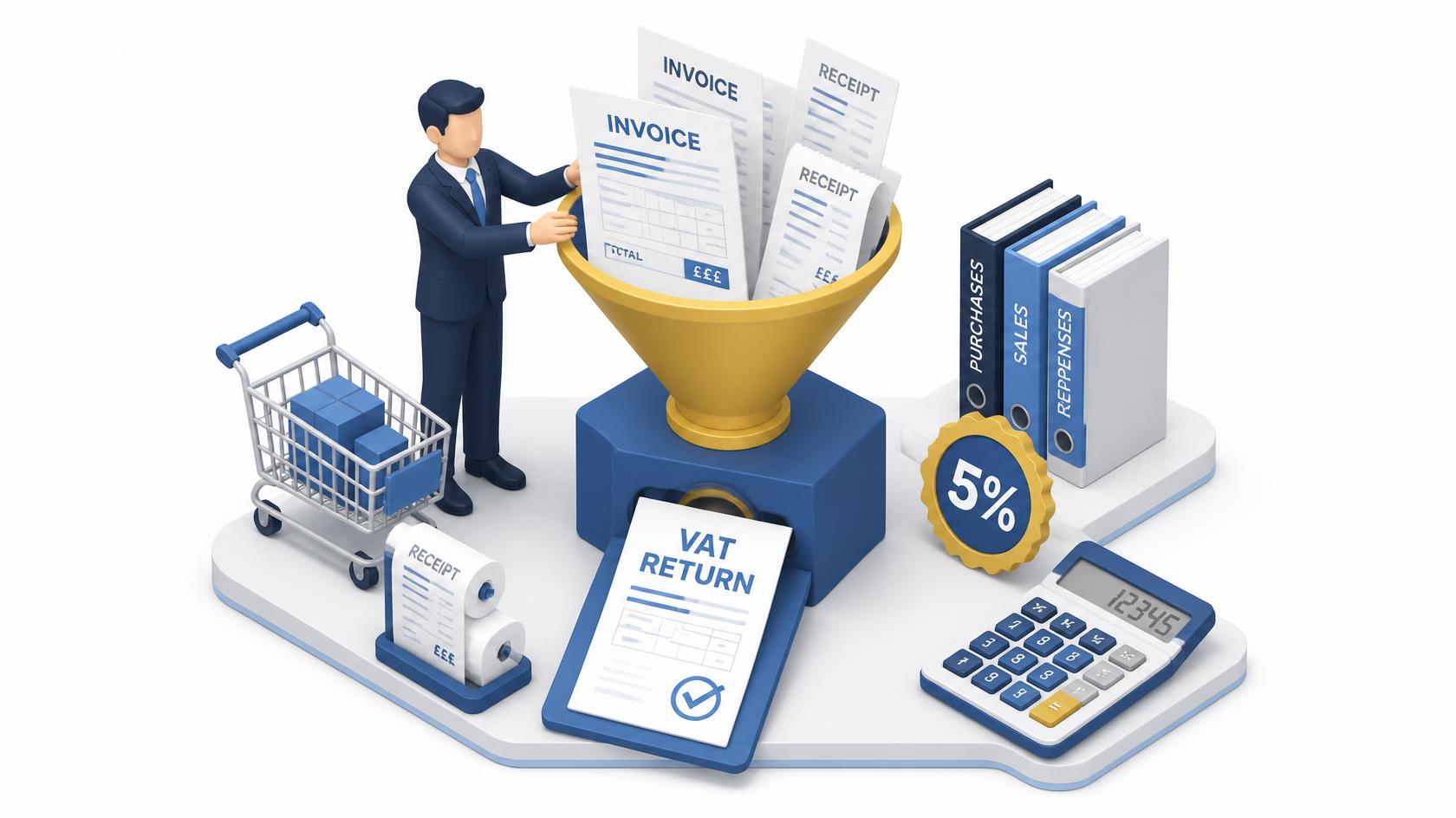
Reconciled to your books, not estimated
VAT Return Filing Services
Your VAT return should reconcile precisely to your accounting records — not be a rough estimate reverse-engineered from bank statements the week the deadline arrives. The gap between those two approaches is exactly where FTA queries originate.
Standard quarterly filing; the FTA can assign monthly for larger or higher-risk registrants
Key facts
| Standard frequency | Quarterly for most registrants |
| Assigned frequency | The FTA can require monthly filing for larger or higher-risk registrants |
| Filing method | Via EmaraTax |
| Common triggers for FTA review | Inconsistencies between filed VAT returns and corporate tax or customs records |
What this actually involves
A properly prepared VAT return traces every figure back to a specific transaction in your accounting records — output VAT reconciled to sales invoices, input VAT reconciled to supplier invoices and import documentation, and any adjustments (bad debt relief, corrections) clearly documented with their own supporting trail. A return built this way withstands scrutiny; one built from a quick bank statement review generally doesn't.
The most common filing errors we correct on takeover fall into a small number of recurring categories: missed reverse-charge entries on imported services, exempt-versus-zero-rated misclassification that quietly compounds a recovery error across every subsequent return, and input VAT claimed on specifically non-recoverable expenses like certain categories of entertainment cost.
Filing frequency itself is worth checking rather than assuming — most registrants file quarterly by default, but the FTA can assign monthly filing to larger businesses or those flagged as higher-risk, and missing an assigned monthly deadline because you were expecting a quarterly one is an entirely avoidable, self-inflicted penalty.
Is this actually relevant to you?
- Your business is VAT-registered and needs ongoing return preparation and filing, whether quarterly or monthly
- You're switching from another accountant or bookkeeper mid-year and want a clean, verified handover of your VAT filing responsibility
- You suspect previous returns may contain classification errors and want them reviewed before the next filing
- You're not certain whether you've been correctly assigned quarterly or monthly filing frequency
Our process, step by step
Return preparation
Reconciled to your actual ledger transaction by transaction, not estimated from bank activity.
Submission & payment coordination
Filed and paid within your specific deadline, whether quarterly or monthly.
Error review before filing
Catching classification errors before submission, not after an FTA query flags them.
Scope of work
Returns are prepared from your bookkeeping. If an error turns up in a past period we handle the voluntary disclosure, and where input tax exceeds output tax we can manage the VAT refund claim.
The classification mistakes that compound quietly
- Missing reverse-charge entries on imported services, which understate the return even when the net cash effect for a fully taxable business would have been nil.
- Treating exempt supplies as zero-rated (or vice versa), which distorts your input VAT recovery position across every subsequent period until caught.
- Claiming input VAT on non-recoverable expense categories, a common error that compounds across each period it goes uncorrected.
Related VAT services in the UAE
From first registration to deregistration — VAT handled end to end, with returns reconciled to your accounts.
Related guides from our team
Practical explanations of the rules behind this service, written by our chartered accountants.
Common questions
How do I know if I've been assigned monthly filing?+
This is communicated directly by the FTA, usually visible in your EmaraTax account — worth confirming rather than assuming quarterly by default, especially after a period of significant growth.
Can you take over filing mid-year without disruption?+
Yes — we start with a reconciliation of your last one to two filed returns against your books before taking over the ongoing cycle, catching any existing issues before they compound further.
What if we discover an error in a return we've already filed?+
This is generally addressed through the voluntary disclosure process rather than simply refiling — see our VAT Voluntary Disclosure page for how that works.
Does filing frequency ever change automatically?+
The FTA can reassess and reassign filing frequency based on your business's size or risk profile — worth checking your EmaraTax account periodically rather than assuming your frequency is fixed indefinitely.
What happens if we file but pay late?+
Filing and payment are generally both required by the same deadline — late payment can trigger its own penalty even where the return itself was filed on time.
Can we file a nil VAT return if we had no transactions in a period?+
Yes, a nil return is still required to be filed by the deadline even where no taxable activity occurred in that specific period.
Ready to hand off VAT return filing?
Tell us your current filing frequency and platform — we'll take over cleanly from your next due date, with a reconciliation check on what came before.